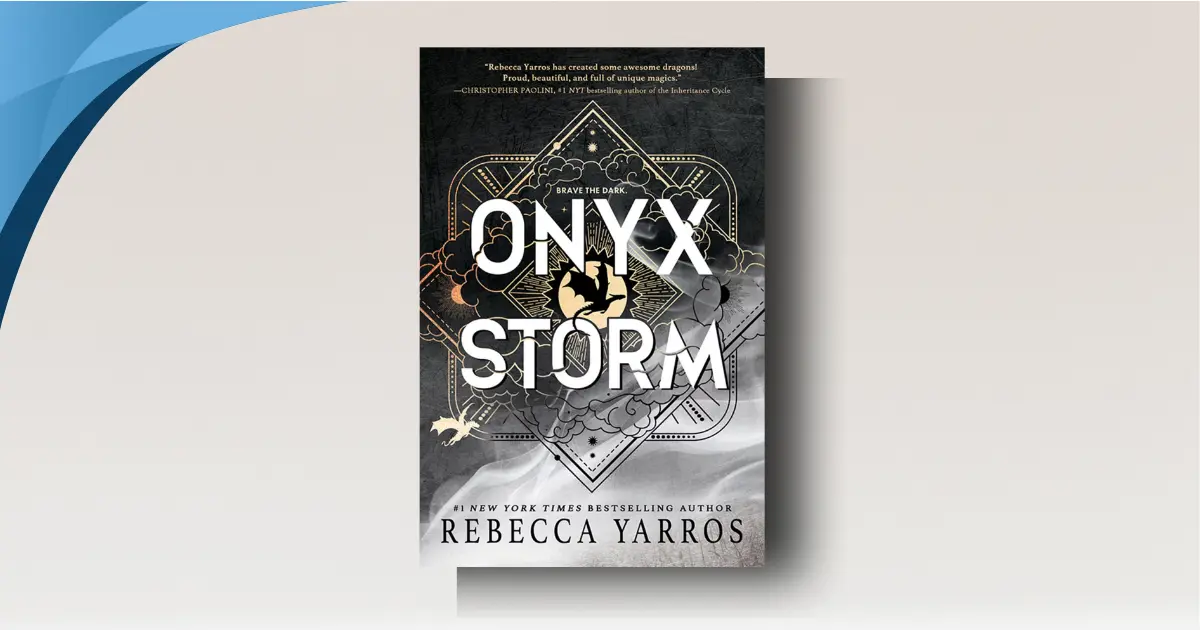
Onyx Storm by Rebecca Yarros: A Personal and Intellectual Exploration of the Fantasy Phenomenon
What if a dragon-rider fantasy could also teach you how to live with grief, chronic pain, and impossible love without ever letting you look away from the battlefield?
Onyx Storm by Rebecca Yarros is a romantasy war epic where Violet Sorrengail finally leaves the academy and discovers that loving someone who might be your enemy is not a weakness but a strategic choice that can reshape an entire continent.
Published on 21 January 2025 by Red Tower Books and running to 544 pages, Onyx Storm is the third Empyrean novel and has already sold about 2.7 million copies in its first week, making it the fastest-selling adult novel in two decades according to The New York Times and People magazine.
This book is best for readers who want high-angst romance, relentless action, disability and chronic-illness representation, and complicated politics in a dragon-rider world shaped by BookTok-era romantasy.
It is not for readers who want tidy morality, low body counts, or discreet fade-to-black romance, because Onyx Storm comes with a printed content warning for “intense violence,” “brutal injuries,” and “sexual activities that are shown on the page.”
Table of Contents
1. Introduction
Onyx Storm by Rebecca Yarros arrives already heavy with expectation.
It follows Fourth Wing (2023) and Iron Flame (2023) as the third entry in The Empyrean series, a new-adult romantic fantasy centred on dragon riders in the militarised kingdom of Navarre.
The novel is published by Red Tower Books, an imprint of Entangled Publishing “First Edition January 2025” and listing multiple formats, from standard hardcover to deluxe and Target-exclusive editions, signalling a franchise that knows its own commercial power. As a physical object it’s branded as an event book: sprayed edges, interior art, and endpaper maps are all credited up front.
From page five, the paratext tells you this is not just another fantasy.
Before the story begins, Yarros dedicates the book “to the ones who don’t run with the popular crowd…who feel like they never get invited, included, or represented,” promising, “Get your leathers. We have dragons to ride.”
That dedication, coupled with a formal content warning describing war, gore, rehabilitation, grief, and graphic language, frames Onyx Storm as both an adventure and a kind of emotional shelter for readers who know what it is to feel fragile or excluded.
The series itself sits firmly in the romantasy boom.
Romantasy—this now-dictionary-shortlisted blend of romance and fantasy—has been driven by the #BookTok community, where readers post tear-streaked reactions, fan theories and annotated copies.
According to The Guardian and industry data, UK science-fiction and fantasy sales rose by 41.3% in 2024, with romantasy named as a primary driver and Rebecca Yarros identified as the leading author in the surge. Her earlier novel Fourth Wing alone sold hundreds of thousands of copies in the UK and stayed on bestseller lists for months.
Yarros herself brings a particular biography to this fictional storm.
She is a New York Times bestselling romance author with more than twenty books, a military spouse whose husband flew Apache helicopters in Iraq, and a woman living with Ehlers-Danlos syndrome, a connective-tissue disorder that informs the way she writes chronic pain into Violet’s body.
That combination—romance craft, military insight, and embodied experience of illness—shapes Onyx Storm’s tone: it is simultaneously tender and ruthless, interested not just in who wins the war, but in what that victory costs bones, joints, and nervous systems.
At the level of narrative stance, the book presents itself as history.
A short note explains that the text has been “faithfully transcribed from Navarrian into the modern language” by Jesinia Neilwart, a Scribe Quadrant curator, and that all events are true and recorded to honour the dead.
This pseudo-archival frame is more than a flourish; it turns Violet’s intimate, first-person voice into a future primary source, like a war diary discovered centuries later, and it sets up the central thesis of the novel: stories are the battleground where truth and power collide.
2. Background
By the time we open Onyx Storm, the Empyrean universe is already a cultural phenomenon.
Fourth Wing and Iron Flame have been credited with revitalising romantasy, with BookTok hashtags for Yarros’ name and titles collectively surpassing a billion views and winning her TikTok Book Awards.
This is not a niche saga quietly loved by a handful of fantasy obsessives; it is a franchise with cosplay, special editions, and even a tabletop game spin-off of Fourth Wing announced with Hasbro, signalling a wider media ecosystem.
Within that ecosystem, Onyx Storm occupies an inflection point.
It’s the book where Violet is no longer contained by the brutal training-college setting that reviewers often summarise as “Hogwarts meets The Hunger Games with dragons and sex.”
Instead of another academic year, we get negotiations, war councils, and cross-border politics, while the venin (soul-draining dark wielders) move from rumour and skirmish to coordinated infiltration.
At the same time, Violet’s soulmate and sometime enemy, Xaden Riorson, has used forbidden earth-channeling to save her life, leaving him something uncomfortably close to the very monsters they’re hunting.
The scale of the readership matters for understanding the book’s “problem statement.”
In its first week, Onyx Storm moved 2.7 million copies, “shattering sales records” and becoming the highest-selling adult novel in twenty years, according to data cited by The New York Times and People.
On Apple Books around late February 2025, it ranked #2 in paid eBooks while its predecessors Fourth Wing and Iron Flame also sat in the Top 10 for both eBooks and audiobooks, showing how tightly readers stayed with Violet’s arc.
When millions of people turn up at midnight launches and crash bookstore websites for a 544-page fantasy about a chronically ill dragon rider and her morally compromised lover, it is fair to ask: what need is this story meeting right now?
The broader context helps.
Reports from Publishers Weekly, The Guardian, and the Berkeley Economic Review all note that BookTok drove an extra 20 million book sales in 2021 alone and contributed to a 21% rise in US bookstore sales between 2019 and 2022, with romantasy singled out as a major growth category.
BBC News and ABC Australia likewise describe romantasy as “hot off the shelves” and even shortlisted as a potential word of the year in 2024.
In that sense, Onyx Storm is both symptom and driver of a market shift where young—often female—readers are unapologetically choosing emotionally intense, sex-positive fantasy over more “respectable” literary fare.
3. Onyx Storm Summary
Key Events, Themes and Lessons at a Glance
Real-world context & dates
- Publication: Onyx Storm (Empyrean #3) by Rebecca Yarros was released on 21 January 2025, as the third book after Fourth Wing (April 2023) and Iron Flame (November 2023).
- Series status: By January 2025, the first three books together had sold over 12 million copies, with Onyx Storm becoming the fastest-selling adult title in 20 years.
Big picture of the plot
- The book opens immediately after the Basgiath battle in Iron Flame: the Navarrian wardstone has been repaired, Violet’s mother Lilith is dead, and Xaden has partially turned venin after channeling dark power to save Violet.
- Venin have already infiltrated Navarre in disguise. They attempt to free Jack Barlowe from prison and want Violet captured alive. This proves the threat is inside the wards, not just outside.
- Navarre’s leadership (the Senarium) pardons the Aretians and restores Xaden’s title as Duke of Tyrrendor, but in exchange, Violet is forced onto a politically controlled mission: a task force to find Andarna’s seventh dragon breed (the irids) and seek a weapon or cure against the venin. (
- That mission becomes a continent-spanning diplomatic and military quest: first to Anca for a citrine gem, then to the southern isles (Cordyn, Deverelli, Unnbriel, Hedotis, Zehyllna and others) to recruit allies and track down the mysterious dragons. Along the way:
- Their official leader, Captain Grady, dies in a preventable fire.
- Xaden is pushed into channeling again, edging closer to full venin.
- The squad negotiates messy alliances, including 40,000 troops from one isle, and has to survive court intrigue, poisoning and ritual “gifts” that kill one of their own, Trager. (
- On a remote volcanic island, they finally meet the irids (Andarna’s kind). The irids declare that humans have failed a centuries-long test of peace, reject Andarna as one of their own, and bluntly state: there is no cure for becoming venin.
- Returning home, Violet learns that Queen Maraya of Poromiel has been assassinated by dark wielders, destabilising the fragile gryphon–dragon alliance. A message from the venin leader Theophanie taunts Violet with the hint that she holds the knowledge Violet seeks.
- In Aretia, Violet develops her second signet: dream-walking, which lets her slip into others’ dreams—first Xaden’s—resetting our understanding of what signets can do.
- A devastating wyvern assault nearly overruns Aretia until a renegade irid, Leothan, secretly powers their wardstone. He then demands that Andarna leave with him. Andarna breaks her bond with Violet and returns to her people, leaving Violet emotionally gutted but militarily safer.
- Theophanie escalates: she kidnaps Mira, Violet’s sister, and lures Violet and Xaden into a massive confrontation in Draithus, promising Violet knowledge and the chance to keep Xaden if she chooses the venin path.
- In the battle of Draithus, both Violet and Xaden are captured. To save Sgaeyl and shift the battle, Xaden finally embraces the venin power completely, unleashing an “onyx storm” of shadows that annihilates wyvern and cripples key venin figures. He is now fully venin—no longer in-between. (
- That shadow surge lets Violet kill Theophanie with a special marble dagger Aaric retrieved via his precognitive signet and a warning from the goddess Dunne, confirming Violet has been touched by the gods.
- When Violet wakes afterward in Riorson House, she has no memory of the previous 12 hours, finds herself wearing a wedding ring, and discovers a legal document proving she and Xaden are married—giving her political claim over Tyrrendor and Aretia. Xaden is missing.
- Her brother Brennan reveals that several riders and elders were slaughtered in a valley and six dragon eggs are missing; four riders (including Xaden and Garrick) are unaccounted for. A new, unnamed rider has turned venin as Xaden’s “brother,” but their identity is left deliberately uncertain.
- In the final line, Imogen confirms she erased Violet’s memories at Violet’s own request, using her memory-altering signet. The reasons—what Violet chose to forget—are the central mystery leading into Book 4.
Core themes and “arguments” the book keeps pressing
- Truth vs. propaganda: Navarre’s official history has deliberately erased the reality of venin and past wars; Violet’s work with her father’s journals and the isles’ records argues that knowing the truth is the only way to survive.
- The cost of power: Every kind of power—dragon magic, venin channeling, royal authority, irid abilities—demands payment in pain, death or corruption. The book’s blunt stance is that there are no clean powers left, only trade-offs.
- Disability and resilience: Violet’s chronic physical fragility isn’t cured; instead, the story treats accommodation, planning and stubbornness as her real weapons. The implicit “argument” is that heroism can coexist with disability rather than erasing it.
- Love, loyalty and self-betrayal: Violet’s refusal to abandon Xaden, even as he slides into full venin, forces her (and us) to ask how far love can go before it becomes complicity. Xaden’s turning is framed as both an act of love and a surrender to darkness.
- Memory and agency: Between Violet’s dream-walking and Imogen’s memory-altering signet, the book keeps circling one question: if your memories can be edited, what does consent really mean, and who controls your story? (
4. Extended Summary
1. Aftermath of Basgiath and the New Shape of the War
The story begins in the wreckage of Iron Flame’s finale.
The Basgiath wardstone has been repaired, protecting Navarre against external venin attacks—for now—but at a terrible cost: General Lilith Sorrengail is dead, leaving Violet grieving and unmoored.
Xaden, meanwhile, has channeled from the earth to save Violet, marking him as venin in the eyes of dragons and enemies alike. He can sense venin now, and they can sense him, a constant reminder that his soul is slowly fraying.
Violet, Xaden, and their allies barely have time to breathe before they realize the threat is already inside.
Venin, disguised as scribes and soldiers, infiltrate Basgiath to break Jack Barlowe out of prison. Their attack leaves desiccated bodies inside supposedly safe walls and proves that the wardstone no longer makes the college a fortress; it simply confines an infection. The venin are vocal about wanting Violet alive—they need the “silver-haired” rider who commands both lightning and an irid.
Politically, the board is reset as well.
The Aretians—branded “deserters” in earlier books—are no longer traitors. Under pressure from Violet, Xaden and Queen Maraya of Poromiel, the Senarium signs a formal pardon, allowing Aretians to stay in Navarre and restoring Xaden’s hereditary title as Duke of Tyrrendor and his seat on the ruling council.
It’s a bargain: they get his military genius and political leverage; he gets a legitimate power base and, crucially, a way to shield Violet under legal protections rather than just dragon fire.
But there’s a catch.
In exchange, the Senarium assigns Violet to a task force to locate and recruit Andarna’s rare dragon breed—the irids, the seventh kind—and to seek any lore that could defeat or cure the venin. Violet wants to lead the mission, but they place Captain Grady in charge and insist that Halden (the young royal heir who knew about venin but did nothing) accompany them, ensuring the mission remains under tight aristocratic control.
Already we can see one of the book’s central arguments forming: those in power will always try to fold even righteous rebellion back into their own structures, unless you fight them for the narrative.
2. Violet’s Promise: A Cure for Xaden, Whatever It Costs
On a personal level, Violet anchors herself to a single goal: find a way to cure Xaden.
She overhears him confronting Jack Barlowe in prison about venin transformation and realises Jack can expose him at any time. To protect Xaden, she turns to Imogen, whose memory-altering signet can wipe Jack’s knowledge. That early gambit sets up the book’s fixation on memory as a battlefield: secrets are not just information; they are survival.
She’s also dealing with Xaden’s own fear.
Xaden cuts off aspects of their telepathic bond, afraid that any slip into channeling (even in the middle of sex) might hurt or corrupt her. He’s haunted by the red flecks in his eyes, the craving to draw power from the earth, and the knowledge that he’s becoming the very thing they’re fighting.
Violet refuses to accept that his fate is fixed, setting up a love story defined not by “can we be together?” but by “can I save you from what you’re becoming?”
Emotionally, that’s the engine of Onyx Storm: every political decision, every alliance, every risk she takes is coloured by that determination “I will save him”, replacing her earlier mantra “I will not die today.”
3. The Anca Mission and Violet Taking Command
The first stage of the task force sends Violet, Captain Grady, Halden and others to Anca.
They’re there to retrieve a citrine gem connected to warding magic and to secure an early alliance. The mission is a mess: Aura Beinhaven, a hot-headed rider, loses control of her power; a fire rips through wooden houses; and their captain, Grady, dies in what feels like a senseless, avoidable disaster, along with one other rider.
When they return, Violet is done being the Senarium’s polite junior.
She publicly confronts the leadership over their incompetence and insists she will only continue the mission if she chooses her own squad and leads it. Reluctantly, they agree. Her new squad blends riders, gryphon fliers, and key political players: Xaden, Mira, Ridoc, Cat, Cat’s cousin Drake, Dain, and Halden (plus a guard) to satisfy royal protocol.
This is a turning point for Violet’s character arc.
She’s no longer the physically fragile first-year trying to survive Basgiath. Here, the book clearly argues that leadership is not granted; it’s seized, often in the wake of mistakes made by those in power.
4. The Southern Isles: Politics, Family and the Slow March Toward Venin
4.1 Cordyn and Deverelli: Xaden Channels Again
From Basgiath they head first to Cordyn, seat of Viscount Tecarus, who acts as their gateway to the southern isles. Tecarus warns them that once they cross the ocean, magic stops—dragons, gryphons, signets, all silenced beyond the Continental boundary.
On Deverelli, magic truly does vanish.
No one can telepathically reach their dragons; Violet and Xaden can’t communicate through their bond; for a few pages, everyone is just human again. King Courtlyn’s court is brutal and theatrically cruel—his panthers are fed human heads at dinner—and Halden manages to infuriate him by offering sacred artifacts and trying to steal back Navarrian heirlooms.
In the chaos, the king orders them killed.
When soldiers threaten Violet, Xaden snaps. In this magic-less environment, the only power available is earth-channeled venin power, and he taps into Violet’s conduit to obliterate a roomful of guards in an instant. His eyes blaze bright red, a visual marker that he’s sliding further into venin territory. Violet has to send him away with Sgaeyl to cool down before he loses himself completely.
Yet Violet still manages to salvage the politics.
She blackmails King Courtlyn with one of his panthers held in Andarna’s jaws and trades the citrine and Andarna’s rare eggshell for an alliance: Deverelli will permit them to use Tecarus’s island manor as a staging ground in future, and Courtlyn is coaxed into offering weapons support in exchange for future dragon-related leverage.
The lesson here is sharp: even when your lover has just committed what looks like a monstrous act, sometimes the only way forward is to treat it as a bargaining chip, not a moral verdict—at least for now.
4.2 Unnbriel: Trial by Combat and the Hint of New Power
The next stop, Unnbriel, is a militaristic island nation.
To earn audience with its queen, Violet, Xaden and Dain must fight three local champions as ritual “champions” themselves. Violet faces a warrior named Marlis. During the fight, lightning strikes in sync with Violet’s will, terrifying Marlis into yielding, which raises questions: was that just weather, or an early sign that Violet’s powers are evolving into something more god-touched?
They gain shelter, but not a firm alliance. The queen is curious about dragons, but refuses to commit troops without more leverage, foreshadowing the transactional nature of future deals.
4.3 Hedotis: Xaden’s Mother and Poisoned Wisdom
On Hedotis, the theme is “wisdom,” but it’s expressed through moral ambiguity rather than gentle study.
The ruling triumvirate uses tests and poisoned cake as a measure of visitors’ insight. Xaden’s estranged mother, Talia, is here, with a new family—two younger sons—and the emotional fallout is immediate. Xaden confronts her for abandoning him once her contract obligations ended, and his discovery of his half-brothers reopens childhood wounds.
During a tense dinner, the triumvirate attempts to poison Garrick; Violet realises the trap just in time and turns the tables by poisoning the triumvirate back with a reversible toxin, forcing them to provide the antidote and honour the terms of their negotiation. Garrick survives but nearly dies, and the squad leaves with a bitter, minimal arrangement rather than true trust.
The book’s “argument” here is subtle: even cultures that idealise wisdom can weaponise it to justify cruelty, and family reunion isn’t automatically healing.
4.4 Zehyllna: Gifts from a God and a Squad Death
In Zehyllna, an island devoted to the god Zihnal and the concept of luck, each squad member has to accept a “gift” drawn at random from ritual cards.
The gifts vary wildly—from simple items to humiliations—but when Trager draws an arrow, it manifests as a real arrow that kills him on the spot, also killing his gryphon Sila.
In exchange, they secure a commitment of around 40,000 troops, a staggering number that could alter the coming war. But the cost is clear: even divine systems that promise fairness or destiny can be brutally indifferent. The “gift” ritual is essentially a sanctified lottery of death.
They burn Trager and Sila together on a separate volcanic isle, both as a funeral and a tactical detour—and that’s where the real core of the mission finally reveals itself.
5. The Irids and the Shattering of Violet’s Hope
On that unnamed volcanic island, the squad encounters a group of irids—the seventh breed of dragon, winged creatures with iridescent colouring and feathertails, who are Andarna’s people.
For Andarna, it should be a homecoming. Instead, it’s a trial.
The irids interrogate her and make it clear that she was deliberately left behind when they withdrew from human affairs, meant to be a “criterion” (or centurion / test subject) to measure whether humans had grown into a peaceful civilisation. Her experience—bonded to a human rider, used in war—counts as a failure.
They deliver two devastating judgments:
- They will not join the war. Humans, in their view, are still using magic as a weapon rather than a tool for balance.
- There is no cure for turning venin. Xaden’s soul, they say, is dying piece by piece; that process cannot be reversed.
Some stay long enough to question Xaden directly. One irid calls him an abomination when his eyes flash with venin taint. Ridoc notices this, forcing Violet to address Xaden’s condition more openly with the squad.
This moment is where Onyx Storm yanks away one of its central comforts.
Up to this point, the narrative left room for a miracle cure—some ancient dragon trick, some lost rune. The irids’ refusal and their “no cure” pronouncement move the story into a darker mode: from now on, saving Xaden is not about undoing his transformation, but about managing its consequences and preserving what’s left of his humanity.
6. Returning Home: Assassinations, Aretia, and Violet’s Second Signet
When the squad returns to the continent, the political map has shifted again.
They learn that Queen Maraya of Poromiel has been assassinated by dark wielders. That is catastrophic: Maraya was the gryphon fliers’ key advocate, and her death threatens to fracture the alliance between Navarre, Aretia, and Poromiel just as it’s starting to matter.
Violet also receives a note from Theophanie, the venin leader who once attacked her and Maren’s family. Theophanie reminds Violet that she holds information Violet desperately wants—knowledge about venin, dragons, and perhaps Xaden’s condition. It’s a taunting invitation and a promise of future confrontation.
Meanwhile, the fragile sanctuary of Aretia is under growing pressure.
Violet and her squad travel there to fight on that front and to support Xaden’s responsibilities as Duke of Tyrrendor. Civilians from Poromiel begin pouring into Tyrr, as Xaden decides that all Poromish citizens should be allowed refuge, stretching resources thin but aligning with his moral commitment to his people.
It’s here that Violet finally manifests her second signet.
She has been experiencing recurring dreams of the venin sage, Berwyn, that feel too vivid, too specific. Eventually she realises they aren’t her dreams at all—they’re Xaden’s. She is dream-walking, able to enter other minds while they sleep. Xaden, impressed and a little alarmed, points out that with practice she might not only visit but manipulate dreams, much like Berwyn does.
This ability is thematically crucial.
It fits the pattern that signets reflect what a rider needs: Violet has always needed information and perspective, and now she can literally step inside other people’s unconscious minds. It also heightens the central question of memory and truth—if Violet can shape dreams and Imogen can erase memories, who will be trusted as a reliable witness when history is written?
7. The Aretian Attack and Andarna’s Departure
Soon after, Aretia faces a massive wyvern assault.
Their defenses are pushed to breaking point; the wards, still unstable, are not strong enough. At the last possible moment, one of the irids, Leothan, uses his own power to fire their wardstone, making it fully functional and turning the tide. Aretia is saved, but Leothan’s motives are not altruistic.
He wants Andarna.
Leothan explains that irids can break, mold and shape magical bonds—which is why Andarna could bond with a human in the first place. He demands that she return with him to learn the ways of their kind. With Violet’s painful blessing, Andarna severs their bond and leaves. Violet loses not only a dragon, but a confidante and symbol of her own exceptionality.
Narratively, this is one of the cruelest moments in the book.
It undercuts the fantasy that Violet’s unique two-dragon bond is a permanent advantage and reinforces the book’s insistence that every power gain will eventually exact a cost. It also strips Violet down before the final battle, making it clear that her choices must come from her, not from lucky extra dragon fire.
8. The Draithus Trap and the Battle That Births the “Onyx Storm”
Theophanie finally springs her trap.
Impatient with Violet’s refusal to choose a side, she kidnaps Mira and lures Violet and Xaden to the city of Draithus, demanding that Xaden deliver both Violet and Jack Barlowe. Everyone knows it’s a setup, but they can’t leave Mira to die. They assemble a force of riders and fliers and head into what is essentially a colossal ambush.
The Battle of Draithus is the most cinematic, chaotic sequence in the book.
- Theophanie, revealed to be a storm wielder like Lilith (not just a lightning wielder like Violet), pins Tairn under a net and tries to seduce Violet with promises: if Violet channels from the earth, she can keep Xaden and her dragons and gain the knowledge she craves.
- Violet refuses, clinging to the belief that using venin power is a moral line she cannot cross, even to save those she loves.
- Simultaneously, Xaden is summoned to a canyon outside the city by his venin sage, Berwyn, where Sgaeyl lies wounded under a similar net. Berwyn forces him into an impossible choice: surrender further to the venin pull, or watch everyone he loves die.
Xaden chooses to fully turn.
He channels deep from the earth, embracing the corruption to unleash an enormous wave of shadows—the titular “onyx storm”—that sweeps across the battlefield. It annihilates wyvern, kills many venin outright, and incapacitates Berwyn and a newly turned venin “brother” whose human identity is left unresolved.
That same surge knocks Theophanie to the ground in Draithus, freeing Tairn briefly.
Seizing the opening, Violet uses a marble dagger given to her earlier by Prince Aaric. He obtained it after a precognitive vision led him to a priestess of Dunne, who warned that only someone touched by the gods could wield it. When Violet stabs Theophanie with it and kills her, it confirms she has indeed been touched or chosen in some way by the divine.
The battle is technically won—but it is not a victory that feels clean.
Xaden is now full venin, no longer balancing between worlds. He departs with Sgaeyl, leaving Violet unconscious and the political landscape more unstable than ever: their main venin maven is dead, but a more unpredictable venin version of Xaden is at large, and a new venin “brother” has been created.
9. The Aftermath: Marriage, Memory Loss, Missing Eggs
When Violet wakes, she is not on the battlefield but in the courtyard of Riorson House.
She immediately realises something is wrong: she is wearing a wedding ring bearing a Riorson heirloom, she has a pounding headache, and she cannot remember the previous twelve hours. In her pocket she finds a legal marriage document, naming her as Xaden’s wife and giving her rights over Tyrrendor and its lands. On the back is a note from Xaden that essentially says: don’t look for me; it’s yours now.
Her brother Brennan and others fill in part of the gap.
They tell her that:
- Four riders and their dragons have been killed in a valley, along with three elders.
- Six dragon eggs are missing.
- Several riders are still unaccounted for, including Xaden and Garrick.
- A new rider has turned venin as Xaden’s “brother,” but no one is sure who. Theories within the text and fandom focus on figures like Garrick, Bodhi, Ridoc or even Brennan, but the book keeps it deliberately ambiguous.
Finally, Violet turns to Imogen.
Imogen, whose primary signet is memory alteration, stands beside her looking guilty. When Violet asks, “What did you do?” Imogen answers, “What you asked me to.” That confirms that Violet herself ordered the erasure of those twelve hours—for reasons she no longer remembers.
We leave her grappling with several unresolved problems:
- She is now Duchess of Tyrrendor and has significant political authority, whether she wants it or not.
- Her husband is a fully turned venin, missing but clearly executing a larger, secret plan.
- An unknown rider has turned venin and may be positioned as an antagonist or tragic figure in the next book.
- Six dragon eggs are unaccounted for; they may be leverage for foreign powers like the southern queen who demanded multiple eggs, or part of a secret dragon strategy.
- Most importantly, she has chosen to forget something crucial. Whether that was to protect others from mind-readers like Dain, to shield Xaden’s plan, or to erase a traumatic choice (such as consenting to Xaden’s full turn or their marriage) is left open, but strongly theorised in commentary and interviews.
5. Main Points, Arguments, Themes and Lessons
Pulling all of this together, here are the big “arguments” Onyx Storm is making across its many chapters and subplots.
1. Truth Is a Weapon, and History Is a Battlefield
Throughout the book, Violet keeps discovering that official histories are lies of omission.
Her father’s journals, the isles’ records, the irids’ testimony, and Queen Maraya’s negotiations all contradict Navarre’s propaganda about the Great War, the venin, and what dragons did or didn’t do.
The central lesson is that who writes history controls what options you think you have.
Violet’s insistence on digging through archives and reading beyond her own country’s narrative isn’t just busywork; it’s a survival strategy. The entire southern-isles mission exists because she believes that somewhere in forgotten texts lies a model or cure or alliance structure that can save them.
2. Power Always Has a Cost (and No One Is Exempt)
Every form of power in Onyx Storm comes with a clearly spelled-out downside:
- Venin power grants enormous destructive force but destroys the wielder’s soul over time, as the irids bluntly explain.
- Dragon power is finite and tied to fragile agreements; Tairn and Andarna can only do so much before they are injured, exhausted, or forced into political choices.
- ** Irid power** can bend bonds and energise wardstones, but its holders are deeply cautious and willing to let whole continents burn if humanity fails their peace test.
- Political power (titles, seats on the Senarium, royal influence) demands compromising with people like Halden, King Courtlyn, or the Senarium—often forcing Violet to swallow tactical losses to keep larger strategies alive.
The book’s stance is that there is no such thing as innocent power. Every choice Violet and Xaden make weighs someone else’s life on the other side of the scale.
3. Disability and Leadership Are Not Mutually Exclusive
Violet’s chronic physical weakness—linked to a connective-tissue condition, as has been discussed in commentary on the series—never goes away.
She suffers dislocations, fatigue, pain, and the constant risk of bones shattering during battle or long flights.
Yet she becomes the de facto leader of the mission to the southern isles, the architect of their diplomatic strategy, and the person whose judgment dragons and riders trust. Her leadership style leans on planning, persuasion, and adaptability rather than brute strength.
The implicit argument: vulnerability doesn’t disqualify you from command; it shapes the kind of commander you become.
4. Love, Loyalty and Self-Betrayal Are All Entangled
Violet’s determination to save Xaden—no matter what—is both her greatest strength and her most dangerous blind spot.
- She insists there must be a cure even when the irids tell her there isn’t.
- She refuses to treat Xaden as lost even when dragons call him an abomination.
- She agrees to a marriage (we know it happened; we don’t yet know exactly what she felt in the moment) that binds her forever to someone drifting into darkness.
Xaden’s own choices mirror hers.
He turns full venin not because he craves power for its own sake, but because he cannot watch Sgaeyl or Violet die. He repeatedly chooses her life over his soul, epitomising the theme that love in this world is never soft or safe; it’s a series of sacrifices, many of them morally ambiguous.
The book doesn’t offer a neat answer to whether those sacrifices are “right.” Instead, it leaves us with a question: when does loyalty to a person become a betrayal of yourself—or everyone else?
5. Memory, Consent and the Right to Your Own Story
Between dream-walking, memory-reading (Dain), and memory-altering (Imogen), Onyx Storm turns memory into contested territory.
The ending crystallises this: Violet voluntarily asks Imogen to remove twelve hours of her own life. We don’t yet know why, but we know she made that choice foregrounding her responsibilities as a leader, a wife, and a rider in a telepathic world full of spies.
The lesson isn’t “never alter memories.” It’s much more nuanced:
- Sometimes, erasing knowledge can be an act of self-protection or strategy; if Dain or venin can read your memories, not knowing may be the safest state.
- At the same time, giving up part of your own story is a radical form of vulnerability; you are trusting that your past self made the right call and that the people around you won’t abuse the gap.
So the unresolved argument the book leaves us with is: how much of yourself are you willing to give up to keep others safe, and does choosing not to know something count as freedom—or as a different kind of prison?
If you think of Onyx Storm as one enormous, storm-lashed chapter in the Empyrean saga, it’s the one where the training wheels come off: Violet leaves the academy, the war spills across seas and islands, Xaden stops hovering at the edge of venin and finally falls, and memory itself becomes negotiable.
Everything after this point—every alliance, every romance beat, every dragon egg—will be shaped by the choices made in these pages, including the choice Violet can no longer remember making.
6. Critical Analysis
6.1 Evaluation of Content
At its heart, Onyx Storm is trying to solve three intertwined problems for its readers.
The first is how to live with chronic pain and grief without letting them define you.
From the opening prologue, Violet is moving through loss: General Lilith Sorrengail, her mother, has died securing the ward system, and Violet chases Xaden through smoke-filled tunnels, forcing her grief into a “mentally fireproof box” so she can function.
The author never hand-waves Violet’s physical limitations; her joints buckle on icy dragon scales, her lower back explodes with pain when Tairn lands too hard, and after an hour in the saddle she’s “lucky [her] hips still rotate.”
Yarros doesn’t name Ehlers-Danlos in-world, but she has spoken openly about drawing on her own diagnosis and on her children’s medical histories when building Violet.
Research on YA and new-adult “sick-lit” suggests that accurate, empathetic chronic-illness representation can help readers feel less isolated and more in control of their identity, and early qualitative studies find that such narratives allow chronically ill teens to see their experiences as meaningful rather than purely tragic.
Onyx Storm slots neatly into that tradition, offering a heroine whose disabilities are neither magically cured nor used as pure inspiration porn; they’re just part of the logistics of saving the world.
The second problem is how to hold onto love when you can no longer be sure what someone is becoming.
By this point in the series, Xaden has channeled directly from the earth to defeat a venin Sage, blurring the line between rider and monster. In Onyx Storm, we see the cost of that choice more clearly: he can now sense other venin, feels the power of the source pulsing beneath his feet, and bluntly tells Violet, “I’m one of them,” daring her to be afraid.
Her answer is simply, “Scared of you? Never,” a line that would be irresponsible if the narrative didn’t also surround it with friends arguing that she should move out of his bed for her own safety.
This is where Yarros’ skill with romance structures shows.
Instead of treating love as a soft counterpoint to the hard military plot, she makes it the testing ground for her moral questions: if Xaden is partially venin, at what point do Violet’s loyalty and determination become naive?
When he admits that he could lead “armies of dark wielders” and would still love her, the novel asks whether love’s persistence is proof of his soul or evidence of its corruption. The text never fully resolves this tension, which is precisely why it works; it leaves readers wrestling with what it means to love someone whose damage might spill over onto you.
The third problem is how to understand power and responsibility in a world built on sanitized history.
One of the most striking pieces of paratext in Onyx Storm is an unsent letter from Violet’s mother, Lilith, worrying that her daughter’s heart will one day overrule her logic and admitting that Violet has “atrocious taste in men.”
Shortly afterwards, a note from Violet’s father (in another section of the book) reminds her that history itself is a construction, composed of stories chosen and preserved by people with agendas.
The combination is deliberate: Violet is literally writing the future historical record of a war in which both Navarre and Aretia, both venin and dragons, have motives obscured by propaganda.
In practical terms, this means that Onyx Storm continually undermines the idea that there is one correct narrative.
We see that in negotiations where Navarrian leaders brand Violet and Xaden as deserters even though they saved Basgiath, in ward-stone politics where choosing to ally with Poromiel is simultaneously treasonous and necessary, and in the way riders from different wings sneer at each other’s sacrifices.
The novel’s structure—with recovered letters, official studies on signets, and Jesinia’s framing edits—invites readers to become historians themselves, weighing sources and asking who benefits from each version of events.
Taken together, these three problems form the central thesis of Onyx Storm:
To survive a collapsing world, you have to make peace with imperfection—in your body, in your lover, and in your country’s stories—while still choosing to fight.
From an evidentiary standpoint, Yarros supports this thesis with a mix of character psychology, world-building, and intertextual nods rather than academic citations, which is appropriate for commercial fantasy but still open to critical scrutiny.
The novel’s emotional logic usually holds.
Violet’s determination to “not die today” and “save him” appears both as a formal addendum to the in-universe Book of Brennan and as her practical mantra during storm-torn patrols and infirmary assaults.
Her choices to keep fighting despite pain are never easy wins; every time she leaps from a dragon or sprints across blood-slick stone, the narrative reminds us of the physical consequences. Xaden’s struggle is similarly grounded: he is repeatedly surrounded by friends who refuse to romanticise his darkness, from Garrick counting the venin they’ve slain to dragons like Tairn openly stating that his soul is “no longer his own.”
Where the logic sometimes strains is in the sheer density of crises.
Reviewers at The Times and elsewhere have argued that Onyx Storm removes the “warm familiarity” of the school setting and piles on “outlandish dangers” and terminology, risking reader fatigue.
I agree that there are moments—such as rapid shifts from venin infiltration to treaty politics to secret missions to find a seventh dragon breed—where the pacing can feel like a never-ending sprint.
Yet in the context of an ongoing war narrative, that relentless escalation also conveys something true about burnout and the way crisis can become a new norm, especially for young people whose worlds have been in upheaval since adolescence.
From a genre perspective, Onyx Storm largely fulfils its stated purpose.
It promises “a nonstop-thrilling adventure fantasy” with high bodily stakes, brutal injuries, and explicit sex, and it delivers exactly that while layering in questions about chronic illness, leadership, and historical narrative.
It meaningfully contributes to romantasy by centring a heroine whose power and fragility are inseparable, and by facing, head-on, the uncomfortable possibility that the love interest might never be cleanly redeemed.
7. Reception, Criticism and Influence
The public reception of Onyx Storm has been both euphoric and contentious.
Within days of release, it topped bestseller charts, with some reports noting that it appeared on lists as early as August 2024 purely on pre-orders alone—months before publication.
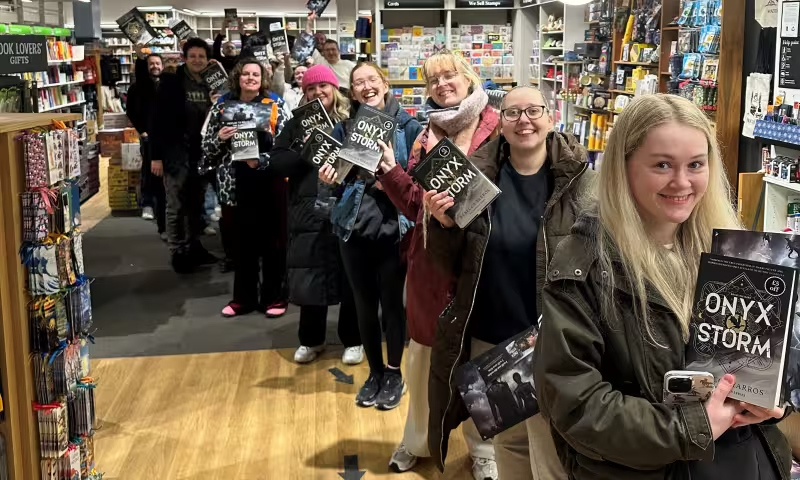
By late January 2025, thousands of fans were attending midnight launch events; The Guardian reported readers lining up at bookshops and describing the release as a major pop-culture moment.
Critically, the novel has drawn both praise and scepticism.
Outlets like BookTrib call it “thrilling and emotionally gripping,” highlighting its world-building and character relationships, while Good Housekeeping emphasises its fast pace and cliff-hanger ending that “leaves fans wanting more.”
On Goodreads, early weeks showed an average rating in the 4.3–4.5 range out of 5, positioning it just behind Fourth Wing and roughly on par with Iron Flame, though some commentators noted that the score dipped slightly as more readers weighed in.
On the critical side, newspapers like The Times have been frank about their reservations.
One reviewer argued that Onyx Storm and Iron Flame lack the focused charm of Fourth Wing, accusing the later books of leaning on ever more extreme magical threats and “cringeworthy” romantic moments, and reading their popularity as evidence that adults are clinging to YA-adjacent comfort reads instead of “more challenging literature.”
I don’t fully share this disdain, but I understand where it comes from: Yarros writes in an unapologetically emotional, accessible register, and she leans into tropes—soulmates, found family, morally grey rebels—that literary gatekeepers have historically dismissed.
Socially and economically, though, the influence is undeniable.
According to BBC and Guardian reporting, romantasy’s rise, with Yarros as a flagship author, coincides with that 41.3% growth in UK SFF sales, the genre’s best year on record.
Studies of BookTok’s impact suggest that videos featuring tearful or giddy reactions to books like Fourth Wing and Onyx Storm helped sell around 20 million extra books in 2021, accounting for nearly half of all social-media-driven book purchases that year.
And then there is the cultural conversation about disability and embodiment.
Blogs and academic work on disability representation increasingly cite characters like Violet as examples of how chronic illness can be integrated into high-stakes genre fiction in ways that feel validating rather than limiting, echoing broader scholarship on disability and contemporary literature.
While I cannot point to a peer-reviewed article focused solely on Onyx Storm yet—its recency makes that unlikely—the novel is already appearing on curated lists of books featuring chronic pain and illness, a sign that readers see themselves in Violet’s daily negotiations with her body. (–)
8. Comparison with Similar Works
Reading Onyx Storm in 2025, it’s almost impossible not to compare it with two neighbouring galaxies: Sarah J. Maas’ works and other dragon-rider fantasies.
Like A Court of Thorns and Roses and Crescent City, Yarros’ Empyrean books combine intricate magical politics with explicit romance and trauma recovery, using enemies-to-lovers dynamics and found family as emotional anchors.
However, where Maas often leans into sprawling fae courts and mythological crossovers, Yarros keeps her focus on military structures: wings, quadrants, chain of command, and the ethics of following or breaking orders.
The war-college framework gives Onyx Storm a grittier, more tactical feel, especially in scenes where patrol reports, ward-stone logistics, and chain-of-command tensions dictate who lives and who dies.
Compared to classic dragon-rider stories like Anne McCaffrey’s Dragonriders of Pern or Naomi Novik’s Temeraire series, Onyx Storm is both more intimate and more bodily.
Those earlier sagas often centre the bond between rider and dragon as quasi-telepathic partnership with heroic overtones; Yarros keeps that, but she layers in intense physical consequences for magical power, from injuries inflicted by venin to the addictive pull of earth-channeling.
Where McCaffrey’s riders tend to be physically capable by default, Violet’s fragility forces creative problem-solving—running logistics rather than brute force, precision dagger work instead of flashy lightning strikes, and negotiations that rely on her knowledge as a scribe as much as on her status as a bonded rider.
Within Yarros’ own bibliography, Onyx Storm reads like a darker, more structurally ambitious cousin to Fourth Wing.
The first book gave us the thrill of discovery: learning the rules of Basgiath, watching Violet claim dragons no one expected her to survive, falling for Xaden’s dangerous charm.
Onyx Storm assumes that emotional investment and spends it ruthlessly: relationships are strained to breaking, old allies become political liabilities, and the narrative voice occasionally steps back to remind us that Jesinia is curating which documents we see, hinting that other archives might tell different stories.
Yet if you read Onyx Storm through the same lens you might use on, say, Being and Nothingness or political memoir, it holds up surprisingly well as an exploration of how individuals make choices inside oppressive systems.
The difference is that here, those choices are punctuated by dragon dives, battlefield triage, and very explicit kissing.
9. Conclusion and Reader Recommendation
When I closed Onyx Storm, what stayed with me wasn’t a single twist or cliff-hanger, but a mood.
It felt like the literary equivalent of waking up the morning after a storm, muscles aching from hauling sandbags, knowing you’re still not safe but also knowing who you trust to stand beside you when the next wave hits.
From an analytical standpoint, the book is not perfect.
There are stretches where the plot’s velocity threatens to outrun character development, and if you’re allergic to popular tropes—soulmates, magical bonds that override logic, “I can fix him” energy—those elements might grate.
There is also a legitimate conversation to be had about how quickly commercial romantasy is being turned into multimedia IP, with TV deals and board games arriving before the series is even finished.
Yet for the readers it is truly for, Onyx Storm feels necessary.
If you’re a fan of romantasy, dragon riders, and morally complicated lovers, this book offers everything the genre promises: high-stakes battles, searing intimacy, and banter that oscillates between life-or-death strategy and bedroom-adjacent teasing.
It is particularly powerful if you live with chronic pain, fatigue, or disability, because Violet’s body is never written as an inconvenience to the plot; it is the plot, a constant negotiation that sits alongside magic and politics rather than beneath them.
On the other hand, if you prefer fantasy that is emotionally restrained, sex-free, or heavily allegorical, you may find Onyx Storm too earnest, too spicy, or too steeped in BookTok culture to be satisfying.
For most general readers curious about why these books are everywhere—from BBC explainers on romantasy to dream-cast threads on social media—Onyx Storm is an ideal case study.
You don’t have to agree with every choice Yarros makes to appreciate how confidently she’s riding this particular storm, or to understand why millions of readers feel, as Violet does when she clenches her jaw and whispers “Every possible path,” that hope sometimes looks like sheer, stubborn refusal to give up.
Read also: All About Love